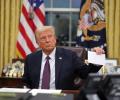
US President Donald Trump signed the National Defence Authorisation Act for Fiscal Year 2026 into law, highlighting broadened engagement with India and addressing the challenge posed by China in the Indo-Pacific region.
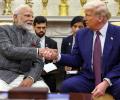
The new US national security strategy signals a retreat from global dominance while reaffirming continuity in India's role in Indo-Pacific security and Quad cooperation, points out former foreign secretary Shyam Saran.

Among major engagements in 2026 is the visit of the European Union leadership, chief guests at the Republic Day parade.

China has made serious inroads into Latin America, which the US may now be hinting is simply not ok: Stay in your lane, Xi! In simple terms, China will no longer have access to Venezuelan oil, points out Rajeev Srinivasan.
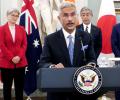
If the only superpower, which calls India an ally, sees the region through an India-Pakistan prism, it is unacceptable. Rather than endorse India's sphere of influence, this undermines it, asserts Shekhar Gupta.
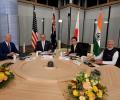
The announcement for the QUAD Caucus came from Congressman Ami Bera, Ranking Member of the House Foreign Affairs Indo-Pacific Subcommittee, Congressman Rob Wittman, and Senators Tammy Duckworth and Pete Ricketts, both members of the Senate Foreign Relations Committee.

US President Joe Biden on Saturday rolled out the red carpet to welcome leaders of Quad countries, Prime Ministers Narendra Modi of India, Anthony Albanese from Australia and Fumio Kishida of Japan.

Prime Minister Narendra Modi will pay a three-day visit to the United States beginning September 21 to attend the annual Quad Summit and address the 'Summit of the Future' at the United Nations General Assembly.

The 2025 US National Security Strategy marks a major pullback, with America turning backward and effectively allowing China greater dominance in Asia. while long-time partners like India are left to face an increasingly unstable global order largely on their own, observes Rajeev Srinivasan.

After the 1962 War with China, there was a demand to forge greater defence cooperation between India and the West. One such voice was that of Sudhir Ghosh, a distinguished MP, to tie up strategic cooperation with the USA immediately after the Chinese attack on India, recalls Rup Narayan Das.

Prime Minister Narendra Modi has said that the Quad is not against anyone, but for a rules-based international order and respect for sovereignty, in a veiled reference to China.

The annual Quad summit at President Joe Biden's hometown Wilmington is expected to roll out a series of new initiatives to boost cooperation in the Indo-Pacific and explore ways to find peaceful solutions to the conflicts in Ukraine and Gaza.

External Affairs Minister S Jaishankar on Monday met United States Secretary of State Marco Rubio for bilateral discussions, as the high-level 80th session of the United Nations General Assembly (UNGA) kicks in.

Gor, 38, was among 107 nominees confirmed by the Senate in a single en bloc vote on Tuesday, with 51 senators voting in favour and 47 against.
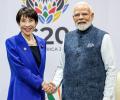
If they act now, they can reshape the strategic map of Asia without firing a shot. If they wait, the next opportunity will come only after a serious Taiwan Strait incident -- by which time the price will be far higher, and the room for boldness far smaller -- the opportunity may well be lost by then. The question is no longer whether this can or should be done, points out Varun Arya.
Saturday's Quad meeting in Delaware is taking place against the backdrop of China's assertive behaviour in the South China Sea, its sabre-rattling in the Taiwan Strait and increasing footprints in the Pacific and Indian Ocean, asserts Rup Narayan Das.
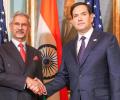
This will be the first face-to-face meeting between Rubio and Jaishankar following President Donald Trump's imposition of an additional 25 per cent tariff on India for Delhi's purchases of Russian oil, taking the total levies imposed on India by the Trump White House to 50 per cent.

The war and Modi's recent visit to Ukraine is expected to figure prominently in the bilateral meeting, according to US National Security Adviser Jake Sullivan.
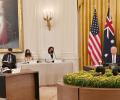
Answering a question about whether Biden will raise the issue of a unified response to Russia, White House Press Secretary Jen Psaki said, "We will convey the same sentiments in this meeting."
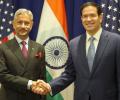
Rubio voiced "appreciation" for New Delhi's continued engagement on bilateral issues, including trade, defence and energy.
External Affairs Minister S Jaishankar says Operation Sindoor conveyed India's resolve to act against terrorism, following UN Security Council's call to bring Pahalgam attackers to justice.
United States Secretary of State Marco Rubio on Thursday (local time) hailed India as 'one of the top relationships that the US has in the world today' during the Senate confirmation hearing for Sergio Gor, US President Donald Trump's nominee for US Ambassador to India.

Meeks, a ranking member of the House Foreign Affairs Committee Democrats, on Wednesday (local time) underscored "Congress' support for the US-India partnership," following his meeting with Indian Ambassador to the US Vinay Mohan Kwatra.

US Secretary of State Marco Rubio claims President Donald Trump was instrumental in bringing about the cessation of hostilities between India and Pakistan, a claim India has consistently denied.

'...it should not delude itself into thinking that India's security or its great-power ambitions will be advanced by those partnerships.'
'Instead, what India should focus on is on riding out the next three-and-a-half years of Trump's presidency with minimal damage to itself.'

Amid US-China trade tensions and economic vulnerabilities, India must seize the 'China +1' opportunity, deepen reforms, secure FTAs, and globalise its firms for long-term growth, suggests Ajay Shah.

The top diplomats of Quad nations on Friday denounced as "inadmissible" any use or threat of use of nuclear weapons in the Ukraine war and strongly opposed any "unilateral actions" that seek to change the status quo in the South and East China Seas, a region that has witnessed increasing Chinese military offensive.
Prime Minister Narendra Modi on Friday said it is important for India and China to work together to bring stability to the world economic order as he asserted that New Delhi is ready to advance bilateral ties from a strategic and long-term perspective based on mutual respect, mutual interest and mutual sensitivity.

Biden has been under attack from his opponents and the Republican Party for his immigration policies as hundreds and thousands of illegal immigrants enter the United States every month.

New Delhi, while opting not to retaliate yet to the American tariffs, has in recent weeks sought to reinforce its friendship with Moscow, and recalibrate its ties with Beijing rather than surrender to Washington's diktats.
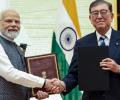
India and Japan have unveiled a comprehensive framework to boost their defence cooperation in response to security challenges, particularly concerning China's increasing military presence in the East and South China Seas.

'However, we must implement a tit-for-tat approach -- reciprocating their conduct with precision.' 'If they demonstrate respect, we respond accordingly. If they adopt hostile positions, we mirror that hostility with equal intensity.'
'New Delhi is not naive about its foreign policy choices.'

Remarks from Indian External Affairs are significant as it comes after China slammed Quad and said the formation of "exclusive cliques" targeting other countries runs counter to the trend of the times and is "doomed to fail".

In the opinion piece after the summit, the leaders said the cooperation, known as "the Quad," was born in crisis. It became a diplomatic dialogue in 2007 and was reborn in 2017.

After the war erupted between Russia and Ukraine, the US and Western nations imposed sanctions on Moscow. However, India has continued to purchase Russian oil.

'The policies announced by his administration are implemented faster.'
'We are a responsible nation, and would prefer to deal with sensitive issues with the maturity they deserve rather than take to social media.'

Former US National Security Advisor John Bolton says President Trump's policies have damaged US-India relations, pushing New Delhi closer to Russia and China.
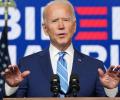
Biden on Friday opened the first Quad Leaders' Summit held virtually and attended by Prime Minister Modi, Australian Prime Minister Scott Morrison and Japanese Prime Minister Yoshihide Suga.
